
Selecting the right Island Freezer for supermarkets and retail stores is a critical decision that directly impacts frozen food presentation, energy consumption, storage efficiency, and overall customer shopping experience, especially in modern retail environments where visual merchandising plays a key role in driving impulse purchases and improving product turnover.
Understanding how to choose the best Island Freezer requires a balanced evaluation of cooling performance, display design, storage capacity, energy efficiency, and long-term operational reliability, because these factors collectively determine whether the equipment will support both commercial profitability and daily operational stability.
Understand Your Store Layout and Product Strategy First
Before selecting an Island Freezer, it is essential to analyze the store layout and product strategy, because different retail environments require different freezer configurations and placement logic.
● Supermarkets with high traffic flow usually require larger island freezer units placed in central aisles to maximize product exposure and encourage impulse buying behavior
● Convenience stores often prefer compact island freezer models that can fit limited floor space while still providing clear product visibility
● Hypermarkets typically use multiple island freezer units arranged in zones based on product categories such as ice cream, frozen meat, and ready meals
● Retail stores with seasonal product changes may require flexible island freezer layouts that allow easy repositioning and product reorganization
Evaluate Cooling Performance and Temperature Stability
Cooling performance is one of the most important technical factors when selecting an Island Freezer, because frozen food quality depends heavily on stable temperature control and uniform airflow distribution across all storage zones.
● The ideal operating temperature for most commercial island freezers is typically around -18°C or lower, ensuring safe long-term storage of frozen products
● Advanced airflow systems are essential to maintain even cooling throughout the cabinet and prevent temperature fluctuations caused by frequent customer access
● Rapid temperature recovery capability is necessary in retail environments where lids or doors are frequently opened throughout the day
● High-quality compressors and efficient evaporators contribute to more stable performance and reduced risk of product thawing or quality degradation
Choose the Right Display Design for Customer Engagement
The design of an Island Freezer plays a significant role in influencing customer behavior, as visual appeal and product accessibility directly affect purchasing decisions in retail environments.
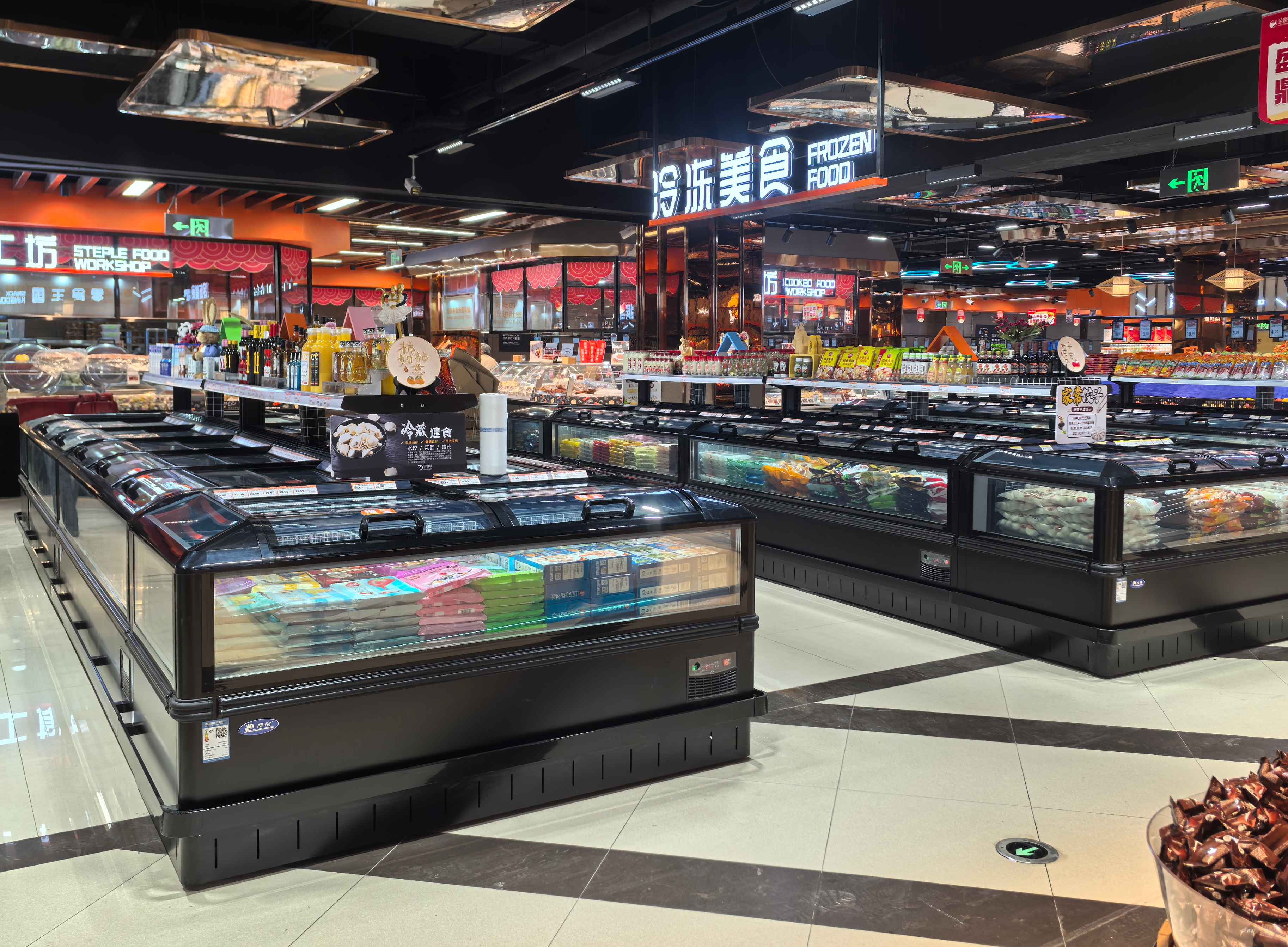
● Glass sliding doors improve product visibility while maintaining better insulation compared to open-top designs
● Transparent display panels help customers quickly identify products without needing to open the freezer frequently
● Internal LED lighting enhances product presentation and increases visual attractiveness, especially for packaged frozen goods
● Organized basket layouts improve product categorization and make it easier for customers to browse different product types
Consider Energy Efficiency and Long-Term Operating Cost
Energy consumption is a major factor in commercial refrigeration, especially for supermarkets that operate multiple units continuously throughout the day, making efficiency a key selection criterion for Island Freezers.
● High-density insulation materials reduce cold air loss and improve thermal retention inside the freezer
● Energy-efficient compressors significantly reduce electricity consumption over long operating periods
● Glass lid designs generally consume more energy than fully closed systems but offer better product visibility and sales performance
● Smart temperature control systems can optimize compressor operation cycles and reduce unnecessary energy usage
Analyze Storage Capacity and Internal Organization
Storage capacity is another critical factor when selecting an Island Freezer, because different retail formats require different levels of product density and categorization efficiency.
● Large-capacity island freezers are suitable for supermarkets that handle high-volume frozen food inventory
● Medium-sized models are more appropriate for retail stores that require balanced storage and display functions
● Internal baskets or partitions help organize products into categories such as ice cream, seafood, frozen vegetables, and ready meals
● Adjustable internal layouts provide flexibility for seasonal product changes and promotional displays
Evaluate Build Quality and Material Durability
Durability is essential for commercial refrigeration equipment, especially in high-traffic retail environments where frequent use and long operating hours are expected.
● Stainless steel interiors provide strong resistance to corrosion and ensure hygienic storage conditions for frozen food products
● Reinforced glass panels improve durability while maintaining clear visibility for product display
● High-quality hinges and sliding mechanisms ensure smooth operation even under frequent opening conditions
● Robust outer casing materials help protect internal components from external impact and environmental stress
Consider Maintenance and Service Accessibility
Maintenance requirements and service accessibility are often overlooked, but they play an important role in reducing downtime and long-term operational costs in retail environments.
● Easy-to-clean interior surfaces help maintain hygiene standards and reduce labor costs associated with daily maintenance
● Modular component design allows for faster repair and replacement of key parts such as compressors and fans
● Accessible condenser units simplify routine servicing and improve long-term system reliability
● Self-defrosting systems reduce manual maintenance requirements and improve operational efficiency
Match Island Freezer Type with Business Needs
Different types of Island Freezers are designed for different commercial applications, and selecting the correct type ensures better alignment with business goals and operational workflows.
● Open-top island freezers provide easy access but require stronger airflow systems to maintain stable temperatures
● Sliding glass door models offer a balance between visibility and energy efficiency, making them suitable for most supermarkets
● Multi-deck island freezer configurations are ideal for large retail spaces that require higher product segmentation
● Compact island freezers are better suited for small retail stores with limited floor space but strong demand for frozen goods
Industry Trends and Modern Developments
The commercial refrigeration industry continues to evolve toward smarter, more efficient, and more visually optimized equipment designs, and Island Freezers are no exception to this trend.
● Smart temperature monitoring systems are increasingly used to track real-time performance and prevent product loss
● LED lighting systems are becoming standard for improving product visibility while reducing energy consumption
● Anti-fog glass technology enhances visibility in humid environments and improves customer experience
● Eco-friendly refrigerants are being adopted to meet global environmental regulations and sustainability goals
Conclusion
Choosing the best Island Freezer for supermarkets and retail stores requires a comprehensive evaluation of cooling performance, display design, energy efficiency, storage capacity, and durability, because each of these factors directly influences product quality, operational cost, and retail performance. A well-selected Island Freezer not only ensures stable frozen food preservation but also enhances customer engagement and increases sales potential in competitive retail environments, making it an essential investment for modern supermarkets.
FAQ
1. What temperature should an Island Freezer maintain?
Most commercial Island Freezers operate at around -18°C or lower to ensure proper frozen food storage.
2. Which is better, glass lid or open-top Island Freezer?
Glass lid models offer better energy efficiency and temperature stability, while open-top models provide easier access.
3. How important is energy efficiency in Island Freezers?
Energy efficiency is very important because these units run continuously and can significantly impact operational costs.
4. Can Island Freezers be customized for different store layouts?
Yes, many models support modular design and flexible configurations to match different retail environments.
5. What products are commonly stored in Island Freezers?
Common products include ice cream, frozen meat, seafood, vegetables, and ready-to-eat frozen meals.
Post time: Apr-13-2026


