
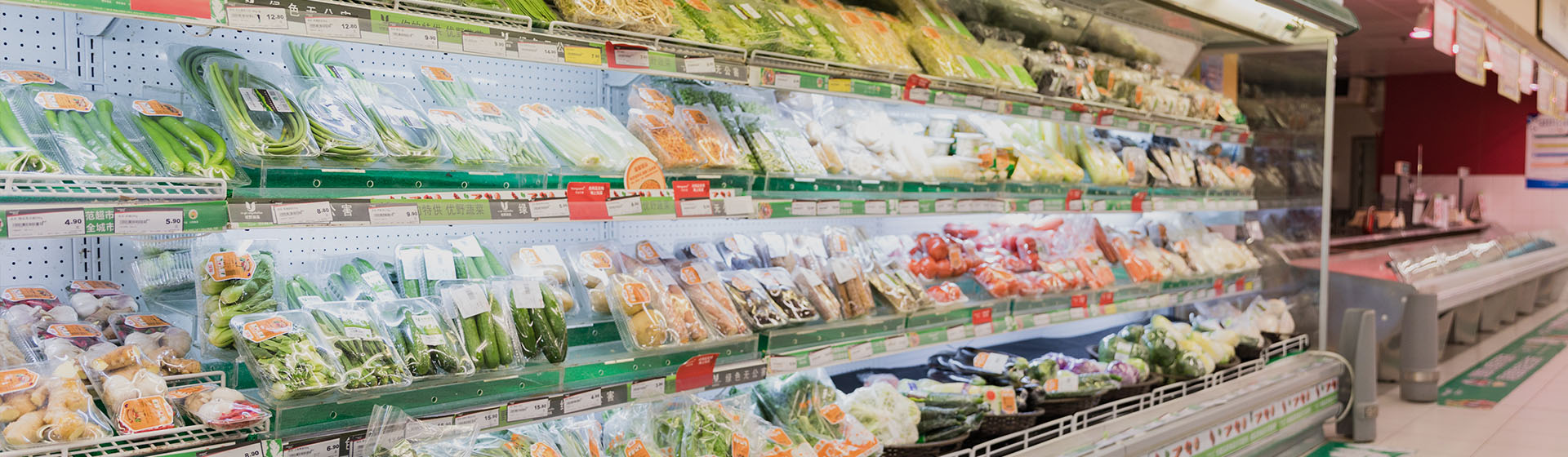
A Glass Door Beer Fridge is a commercial beverage refrigeration product designed to keep bottles and cans within a defined chilled range while allowing the contents to remain visible through closed doors. Unlike a general storage refrigerator, a Glass Door Beer Fridge must balance product temperature, glass‑door heat gain, repeated access and usable shelf capacity at the same time. The correct starting point is therefore the complete product under its expected load, not only its door count or exterior appearance.
This product‑level view matters because an empty Glass Door Beer Fridge may pull down quickly and still recover slowly after a large delivery of warm beverages is loaded. Stable operation depends on how the cabinet, refrigeration system, insulated glass, door seals, airflow and condenser ventilation work together under the expected ambient condition. The product should be evaluated as it will actually be used: loaded with representative packages, opened at a realistic frequency and installed in a real commercial environment.
Glass Area Changes the Heat‑Load Calculation
The glass door is the defining feature of a Glass Door Beer Fridge, but it is also part of the cabinet’s thermal boundary. Heat moves through glass more readily than through a heavily insulated solid panel. A larger viewing area can therefore increase the load that the refrigeration system must remove. Multiple panes, low‑emissivity treatments, frame design and reliable gaskets help control that transfer, while door‑frame heating or another anti‑condensation solution may be used when visibility must be maintained in humid conditions.
Bottles and Cans Do Not Cool Like Empty Air
Beverages add far more thermal mass than the air inside the cabinet. When a large quantity of relatively warm bottles or cans is loaded at once, the system must remove heat from the liquid, the package and the surrounding air. That process takes longer than cooling an empty cabinet. A temperature display may begin to recover before the centre of every beverage has reached the intended condition, so pull‑down performance should be assessed after a representative load rather than from an empty test.
Shelf Layout Can Protect or Block Airflow
Adjustable shelving is valuable only when the new positions preserve the designed circulation path. Cold air normally needs a clear route from the evaporator or discharge area, across the product zone and back to the return opening. Deep rows of cans, tall cartons or packages pushed against the rear panel can create sheltered warm areas even when the thermostat setting is correct.
- · Keep products within the specified loading boundary and away from supply or return openings.
- · Leave enough vertical clearance for air to move above bottle shoulders and carton tops.
- · Match shelf strength to the concentrated weight of glass bottles, not only to shelf dimensions.
- · Use shelf spacing that supports both package height and circulation instead of maximizing the number of levels at any cost.
- · Check temperature at more than one shelf position when the cabinet carries mixed package formats.
A cabinet that performs evenly with one shelf arrangement may behave differently after shelves are added or heavily loaded. For that reason, useful capacity is not the same as the largest physical quantity that can be fitted inside. Useful capacity is the quantity that can be cooled while airflow, access and door closure remain unobstructed.
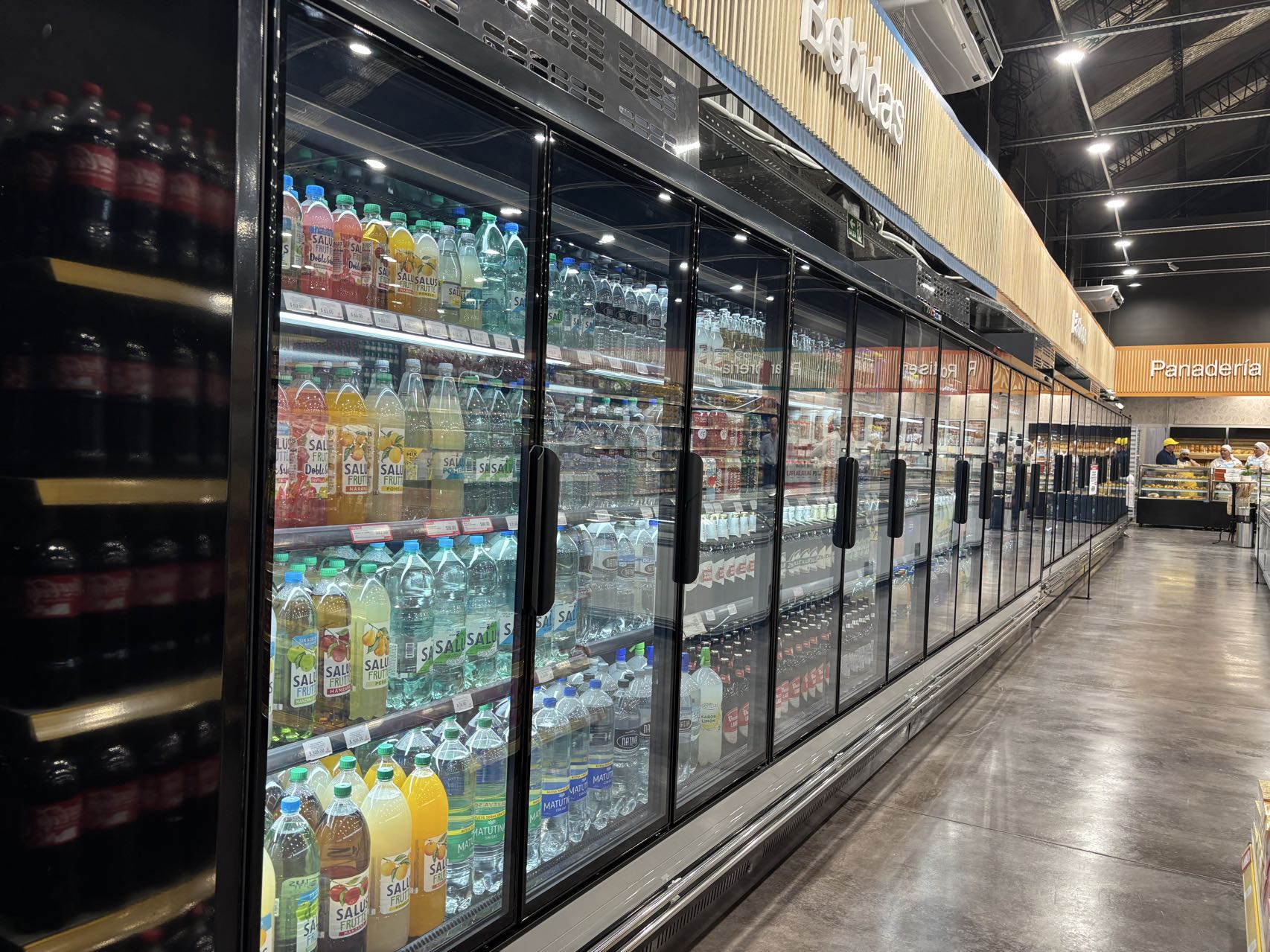
Door Opening Is a Recovery Test
Every opening allows warm, humid air to enter. The key performance question is not whether the temperature changes, because some change is unavoidable, but whether the cabinet returns to its normal operating band in a predictable way. Door size, opening duration, gasket contact, self‑closing behaviour, fan operation and refrigeration capacity all influence recovery.
Condensation Is a Diagnostic Signal
Moisture on the outer glass does not automatically prove that the refrigerator is underpowered. Condensation forms when the glass surface falls below the dew point of the surrounding air. High humidity, strong air‑conditioning drafts, a disabled heater, poor frame insulation or air leakage around the gasket can all contribute. Moisture between glass panes points to a different problem: the insulated glass assembly may have lost its seal.
Installation Must Allow the Plug‑In System to Reject Heat
Many commercial glass‑door beverage cabinets use a plug‑in refrigeration system. The cabinet removes heat from the beverages and releases that heat through its condenser into the surrounding room. If the condenser intake or discharge is blocked, or if the cabinet is enclosed without adequate clearance, condensing temperature can rise and cooling performance can deteriorate. Dust on the condenser has a similar effect.
Information to Confirm Before Final Specification
A reliable quotation and configuration should be based on operating inputs, not only a photograph or requested door count. The most useful information includes:
- · beverage types, package dimensions and the mix of cans, PET bottles and glass bottles;
- · target chilled range and any products with different temperature requirements;
- · quantity and temperature of stock loaded during the largest refill;
- · expected door‑opening frequency and daily service pattern;
- · room temperature, humidity, ventilation and nearby heat sources;
- · available voltage, plug type, installation width and service clearance.
When these conditions are known, a Glass Door Beer Fridge can be selected as a complete cooling product rather than as a display cabinet with an assumed performance. That approach supports more stable beverage temperature, clearer glass, more usable shelf capacity and easier long‑term maintenance.
FAQ
1. Why can the top and bottom shelves show different temperatures?
Shelf loading, air‑discharge position, return‑air blockage and door infiltration can create different conditions between levels. Check the loading boundary and airflow path before changing the thermostat.
2. Does a glass door always use more energy than a solid door?
Glass generally transfers more heat than an insulated solid panel, but actual consumption depends on glazing, seals, anti‑condensation control, door use, ambient condition and refrigeration‑system efficiency.
3. Why does the cabinet recover slowly after restocking?
A large warm beverage load adds substantial thermal mass. Recovery depends on load temperature and quantity, airflow around packages, refrigeration capacity and whether condenser ventilation is clear.
4. What should be checked when condensation appears?
Record room humidity, the location of moisture, door sealing, heater operation, airflow around the cabinet and whether moisture is outside or between the panes. Do not assume that a lower thermostat setting will solve it.
Post time: Aug-17-2026


