
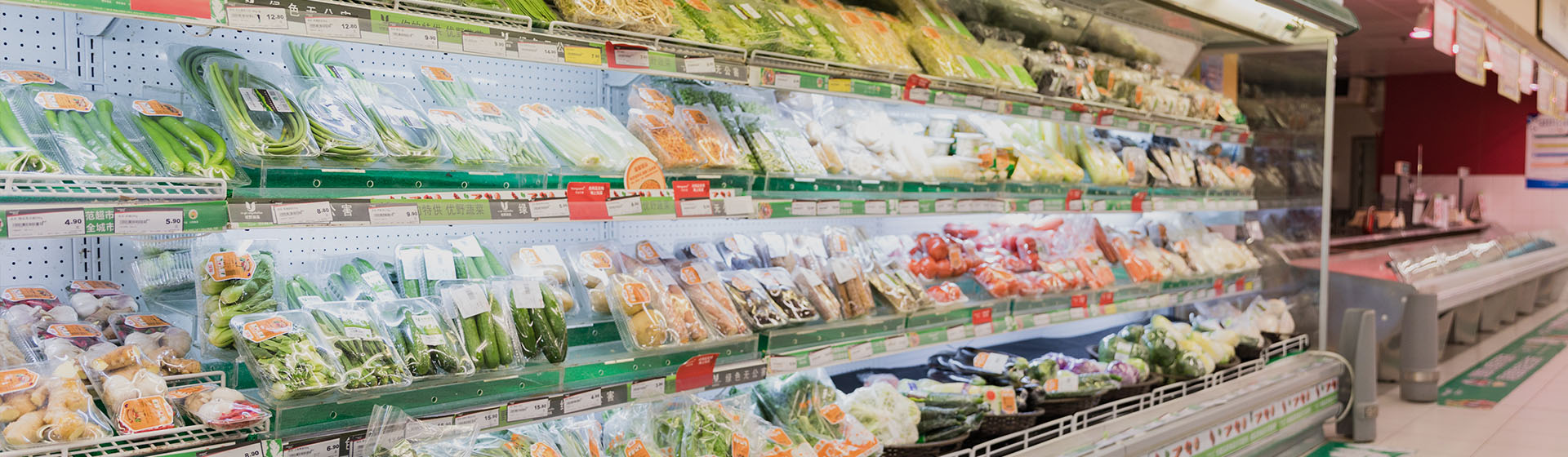
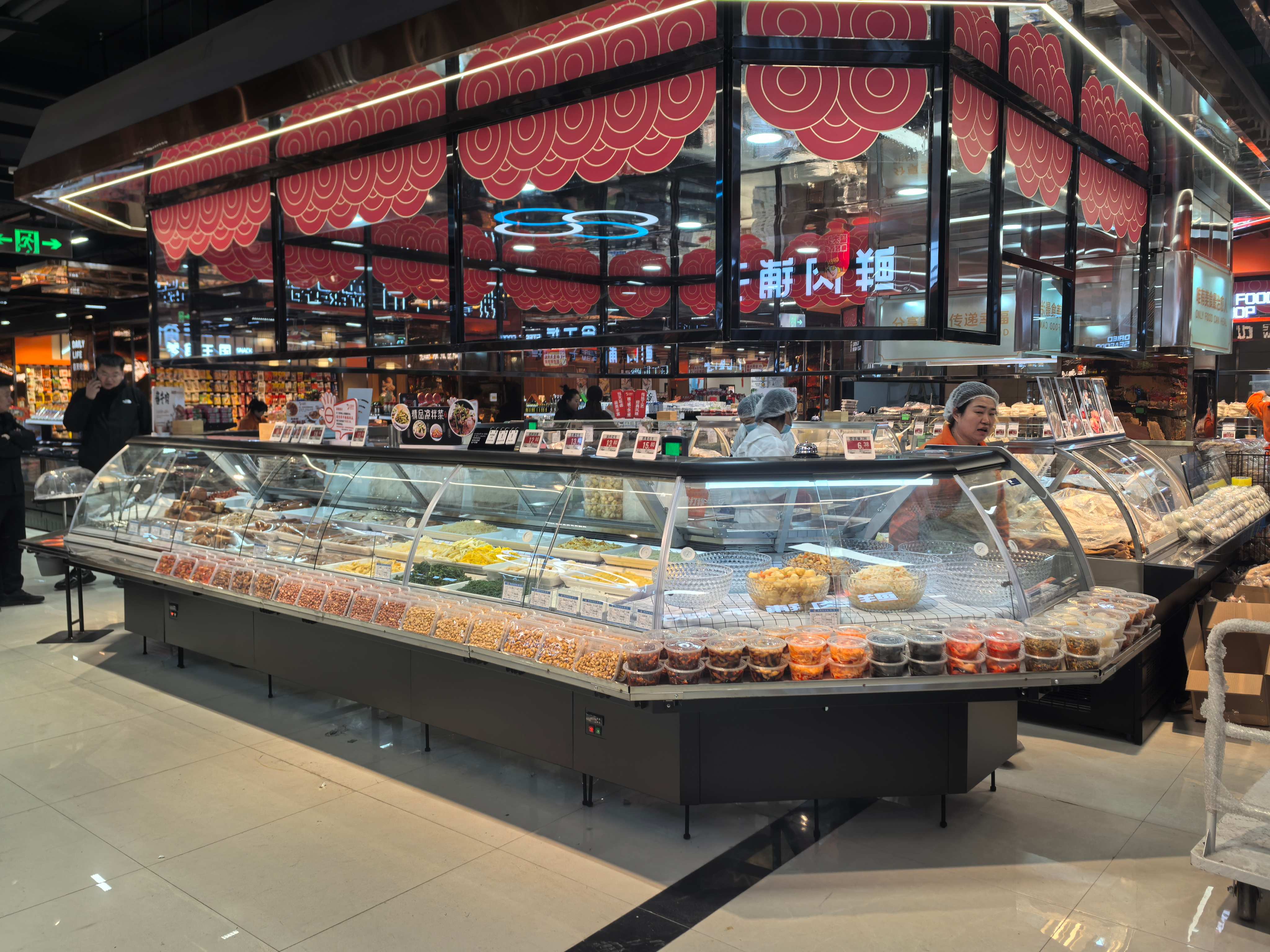
A Counter Supermarket Display Food Showcase is a horizontal refrigerated cabinet built to present chilled food across a customer-facing counter while giving staff practical access from the service side. Its product value is not limited to maintaining a low temperature. The cabinet also controls what customers can see, how products are arranged across the display surface, how service staff reach the food, and how the complete counter looks when several sections are installed together.
This type of showcase is suitable for deli foods, cheese, prepared dishes, packaged chilled items, sliced products, salads, and other foods that match the cabinet’s operating condition. The most useful way to understand it is as a display counter with refrigeration integrated into the product architecture.
The Front Glass Defines the Customer’s View
The first job of a Counter Supermarket Display Food Showcase is to create a clear customer-facing presentation. The display area sits below the normal eye line, so the glass angle, cabinet height, interior lighting, tray position, and product depth all influence what can be seen.
A long showcase should maintain the same visual line across its full length. If the glass height or internal deck changes suddenly between sections, the counter can look fragmented. Consistent geometry helps individual cabinet modules read as one continuous food display.
Inside the showcase, the products should be arranged so the front row does not completely hide the back row. Large containers may need to sit lower or farther back, while smaller packs can be positioned closer to the glass. The objective is to make the usable depth visible rather than simply filling the deck.
Display Area Is More Useful Than Empty Volume
Published showcase specifications may include dimensions or display-area figures, but actual usefulness depends on how much of the surface can carry products without blocking airflow, access, or sightlines.
A Counter Supermarket Display Food Showcase can have a large internal cavity and still provide a poor display if only the front strip is easy to see. Conversely, a well-proportioned deck can make a moderate cabinet look spacious because the full depth remains visible.
The practical display area depends on:
- Clear width between structural frames.
- Usable front-to-back deck depth.
- Tray dimensions and product height.
- The location of air outlets and return grilles.
- Glass angle and front-edge height.
- Staff access from the rear.
These factors determine how much of the cabinet becomes genuine refrigerated presentation space.
A Deli Showcase Needs Stable Conditions across the Full Length
Horizontal counters can be long, and long cabinets create a challenge: the front, rear, center, and end sections all need to remain within the intended operating condition.
The refrigeration system must move cooled air through the display zone without allowing one end to become consistently warmer or another zone to receive excessive direct airflow. Product loading has a large influence on this pattern. Tall trays, decorative liners, packaging, or signs can interrupt the designed path.
For a Counter Supermarket Display Food Showcase, temperature checks should therefore consider several product positions. A controller reading is useful, but it does not show whether one tray beside the glass or near an end panel behaves differently from the center of the deck.
The product is working well when the complete usable display surface remains predictable under normal loading and service activity.
Service Access Should Support Fast, Controlled Replenishment
The staff side of the cabinet is just as important as the customer side. Employees need to place new trays, remove products, clean the deck, update labels, and reorganize the display without leaving the cabinet open unnecessarily.
A good service arrangement shortens these actions. Frequently handled products should sit close to the normal working position. Large trays should be removable without turning them sideways through a narrow opening. Rear doors or access panels should close completely after use.
Replenishment can also be organized by zones. Instead of opening or disturbing the full counter, staff can work on one section at a time.
A simple routine helps:
- Prepare replacement products before opening the cabinet.
- Remove empty or damaged packs first.
- Refill one zone rather than the entire display at once.
- Keep air openings clear after restocking.
- Check that access panels are fully closed.
Lighting and Glass Should Present Food Naturally
Display lighting should make products clear, not artificial. For deli food, customers often judge freshness through color, surface condition, package clarity, and overall cleanliness.
Efficient internal lighting can improve visibility without adding excessive heat. Its position should reduce shadows behind deep trays and limit glare on the front glass. Glass cleanliness is equally important because marks or condensation directly affect the value of the transparent display surface.
The Counter Supermarket Display Food Showcase should therefore be viewed as one optical system: glass, light, tray height, product color, and cabinet background all contribute to the final appearance.
Cabinet Modules Can Build a Longer Food Counter
One showcase may be enough for a compact food area, while several compatible modules can form a longer deli line. Repeating the same cabinet family keeps glass height, work level, display depth, lighting style, and exterior finish consistent.
This modular approach is useful when the product range includes several categories. One section can carry sliced meats, another cheese, another prepared foods, and another packaged items. The cabinet line remains visually unified while the internal presentation changes by category.
The refrigeration arrangement still needs to support the complete installation. Plug-in and remote systems have different site requirements, and the final solution should match the length of the counter, ambient conditions, and available infrastructure.
The Showcase Should Make Food Easier to See and Easier to Serve
The most successful Counter Supermarket Display Food Showcase does not force a choice between presentation and daily operation. Its glass lets customers understand the product range, while the service side allows staff to reach the same products without disturbing the entire display.
That balance is what separates a purpose-built refrigerated food showcase from a simple cold storage cabinet. Display depth, glass geometry, lighting, access, refrigeration, and modular cabinet length all support the same goal: keeping chilled food visible and organized through the service period.
FAQ
1. What products are suitable for a Counter Supermarket Display Food Showcase?
It is commonly used for chilled deli food, cheese, prepared dishes, salads, sliced products, and packaged chilled foods that match the cabinet’s operating range.
2. Why is display area more important than gross volume?
Customers only benefit from the portion of the cabinet that remains visible, refrigerated, reachable, and properly organized. Empty internal volume does not automatically become useful display space.
3. Should temperature be checked in more than one place?
Yes. Long horizontal cabinets can have different conditions at the center, ends, front, and rear, especially when loading affects airflow.
4. Can several showcases be installed together?
Compatible modules can form a continuous food counter if cabinet geometry, refrigeration, service clearance, and site conditions are planned as one system.
Post time: Sep-03-2026


