
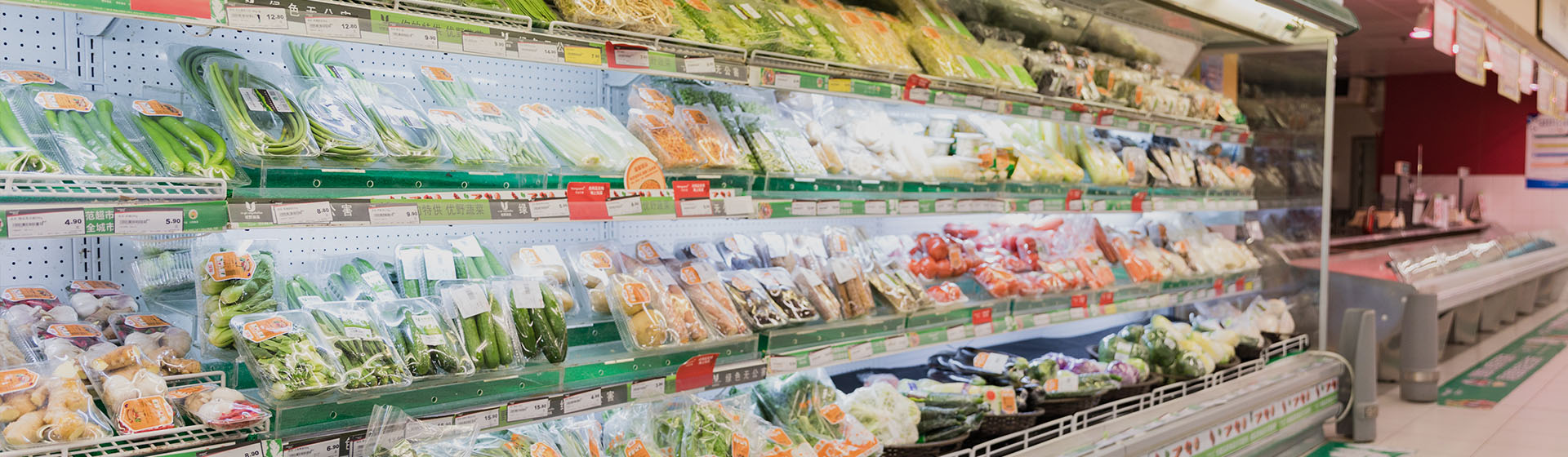
A Supermarket Meat Showcase Fridge has to protect more than a low storage temperature. Fresh meat is displayed under bright lighting, exposed to repeated service activity, and judged visually within seconds. If the cabinet produces uneven cooling, excessive airflow, condensation, or poor product organization, the meat may lose its natural color, develop dry edges, or appear less fresh even before its safe storage period has ended.
For supermarkets, butcher counters, delicatessens, and fresh food departments, the most useful cabinet is therefore not simply the coldest model. It is a display system that keeps product temperature stable, controls surface moisture, supports hygienic work, and allows staff to replenish the counter without disturbing the entire presentation.
How a Supermarket Meat Showcase Fridge Performs Across a Full Service Day
The operating conditions of a meat counter change continuously. Early in the morning, the cabinet receives a relatively large loading volume. During busy periods, staff repeatedly open service doors, remove trays, weigh products, and return partially used stock. Near closing time, remaining products must be checked, rotated, or transferred according to the store’s food-handling procedure.
A suitable fresh meat display refrigerator should handle these changes without creating large temperature differences between the front, rear, upper, and lower product zones. The refrigeration system must recover after service activity, but recovery should not rely on an aggressive stream of cold air that dries exposed meat surfaces.
Three moments are especially demanding:
• Morning loading, when too many products may be placed into the cabinet at one time.
• Peak service, when doors and rear access panels are opened frequently.
• Late-day display, when smaller quantities can be more exposed to airflow and lighting.
Evaluating performance across this full cycle gives a more realistic picture than checking only the controller temperature when the cabinet is empty.
Fresh Meat Display Is Not Only a Temperature Problem
Fresh meat appearance is influenced by temperature, humidity, airflow, light, packaging, and time. A cabinet can remain within its nominal temperature range while still creating poor display conditions. Strong airflow may accelerate moisture loss, while stagnant zones can allow local temperature rise. Condensation on glass may hide products, and excessive lighting can add heat or distort natural color.
The goal of a refrigerated meat showcase is to create a balanced microclimate around the product. For packaged trays, the cabinet needs stable air temperature and clear visibility. For unpackaged cuts in a service counter, surface protection becomes even more important because the product is directly exposed to the cabinet environment.
Useful performance indicators include:
• Consistent product temperature at different positions, not only stable return-air temperature.
• Limited drying or darkening around exposed edges.
• Clear front glass during normal humidity conditions.
• Fast recovery after access without excessive fan force.
• Even lighting that shows the product naturally.
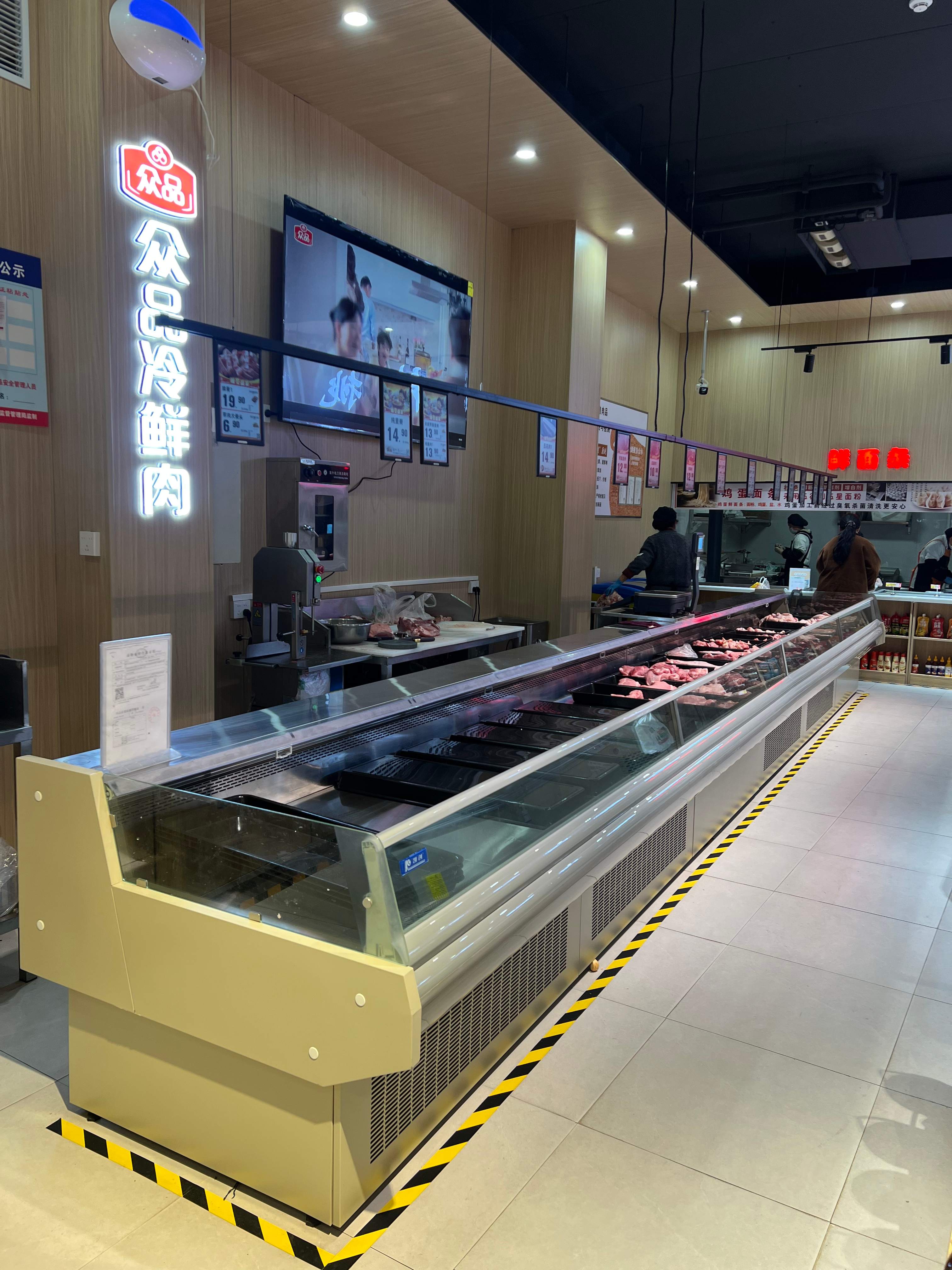
Product Zones Should Follow the Way Meat Is Prepared and Served
A meat display becomes easier to operate when the interior arrangement reflects actual product categories. Large primal cuts, portioned steaks, minced meat, poultry, sausages, marinated items, and packaged trays do not require the same amount of space or the same service frequency.
A practical layout may reserve the center zone for high-turnover products, use side areas for specialty cuts, and keep heavier trays on stable lower surfaces. In a double-layer meat showcase, the upper level can improve display capacity, but it should not block lighting or disturb airflow to the lower deck.
Before defining the layout, check:
• Typical tray width, depth, and height.
• The largest cut that will be displayed.
• How often each category is replenished.
• Whether products are served from the rear or selected from the front.
• Where scales, wrapping materials, and utensils are positioned.
• How older and newer stock will remain separated.
A cabinet that looks spacious can still be inefficient if staff must move several trays to reach one product. Good zoning reduces handling time and helps preserve a neat presentation during busy hours.
Temperature Uniformity Depends on Airflow, Insulation, and Defrost Control
Airflow should protect the product surface
In many meat showcases, cold air moves across the display deck and returns through designated openings. If products cover these openings or extend beyond the loading line, circulation becomes uneven. The front row may warm while products near the outlet become too exposed to cold air.
Staff should receive clear loading guidance, and the cabinet should provide visible limits or a layout that naturally discourages overfilling.
Insulation reduces hidden heat gain
High-density insulation limits heat transfer through the cabinet body. This improves temperature stability and reduces the need for continuous compressor operation. Attention should also be given to joints, service doors, and end panels, since poorly sealed areas can introduce heat and moisture.
Defrost must remove ice without disturbing the display
Frost on the evaporator reduces airflow and cooling efficiency. However, an unsuitable defrost cycle may allow the display temperature to rise unnecessarily. Defrost timing, drainage, and fan restart should be coordinated so that moisture is removed and normal airflow returns smoothly.
Daily Hygiene Is Easier When the Cabinet Is Designed for Cleaning
Fresh meat counters require frequent cleaning because juice, packaging fragments, labels, and small food particles can accumulate around trays, corners, drains, and service openings. A meat display cabinet should therefore be designed around cleaning access rather than treating sanitation as an afterthought.
Useful features include removable display decks, rounded internal corners, accessible drains, smooth stainless-steel work surfaces, and components that can be lifted without special tools. Staff should be able to inspect hidden areas, because residue that cannot be seen during routine wiping may still affect hygiene and odor.
A basic daily procedure can include:
• Removing products according to the store’s temperature-control procedure.
• Cleaning trays, decks, glass, and service surfaces.
• Checking drains and removing packaging debris.
• Inspecting door seals and rear access panels.
• Confirming that cleaned parts are dry before reassembly.
Cleaning chemicals and methods should follow equipment and food-safety instructions to avoid damaging coatings, seals, sensors, or electrical parts.
FAQ
1. What temperature should a Supermarket Meat Showcase Fridge maintain?
The required range depends on the type of meat, packaging, local regulations, and operating procedure. Product temperature should be verified at several display positions rather than relying only on the controller reading.
2. Why can fresh meat dry out inside a refrigerated showcase?
Excessive airflow, low humidity, long display time, poor positioning, or direct exposure near an air outlet can increase surface moisture loss. Loading arrangement and airflow design should be reviewed.
3. Can packaged and unpackaged meat share the same cabinet?
They may be displayed in the same system only when hygiene separation, temperature requirements, airflow, and local food-handling rules are properly addressed. Clear zoning is essential.
4. Why does condensation appear on the front glass?
Condensation can result from high room humidity, disturbed airflow, frequent opening, low glass surface temperature, or insufficient anti-fog control. Both cabinet settings and installation conditions should be checked.
Post time: Jul-31-2026


