
A Sliding Door Refrigerator is often selected because of its door design, but the real value of this type of refrigerator goes beyond the way the doors open. In commercial refrigeration, the available cabinet volume does not always represent the amount of space that can be used efficiently. Door movement, shelf arrangement, product dimensions, cabinet depth, and access to different storage areas all affect how much of the refrigerated space can actually be put to work.
For applications where products need to remain organized and accessible while the available floor area is limited, a sliding-door configuration can provide a practical way to balance storage capacity with operating space. The key is to look at the refrigerator as a complete storage system rather than judging it only by its external dimensions.
What Problem Does a Sliding Door Refrigerator Actually Solve?
One of the most noticeable limitations of a traditional hinged-door refrigerator is the space required in front of the cabinet. When the door swings outward, the surrounding working area has to accommodate both the door and the person standing in front of it. This can become inconvenient when several pieces of equipment are installed close together.
A Sliding Door Refrigerator changes this relationship because the door moves horizontally instead of extending far into the working area. The refrigerator can therefore be positioned in a relatively compact layout while still allowing access to the refrigerated compartment. This can be particularly useful in commercial kitchens, preparation areas, food storage rooms, and other environments where equipment and working paths have to share limited floor space.
The important point is that the space saved is not necessarily inside the cabinet. It is mainly the operating space outside the cabinet. That difference matters when planning the overall layout of a commercial refrigeration area.
Cabinet Capacity Is Not the Same as Usable Storage
A refrigerator may have a large nominal capacity, but that does not automatically mean every part of the cabinet can be used efficiently. Internal dimensions determine how products fit into the available space, while shelf positions determine how much of the vertical volume can actually be occupied.
For example, a cabinet that is very deep may provide a large theoretical capacity, but smaller packages placed at the rear can become difficult to reach. On the other hand, a well-arranged cabinet with practical shelf spacing can make better use of the same overall volume because products can be grouped according to their size and frequency of access.
This is why the dimensions of the products being stored should be considered alongside the refrigerator dimensions. Beverage containers, packaged food, prepared ingredients, trays, and containers can require very different combinations of shelf width, depth, and height.
Why Can Two Refrigerators With Similar Capacity Feel Completely Different?
The difference often comes from internal organization.
Imagine two refrigerators with similar external dimensions. One has shelf levels that match the height of the products being stored, while the other leaves large amounts of unused space above shorter products. The two units may have similar rated capacities, but the practical storage experience can be very different.
Shelf depth also matters. If the shelves are too deep for the products, items can be pushed toward the back and become difficult to identify or remove. If they are too shallow, part of the cabinet volume may remain unused.
A more effective arrangement usually begins by identifying the main product dimensions and then considering how those products can be grouped within the cabinet. In this sense, the refrigerator should be treated as a combination of cabinet volume and storage geometry rather than simply a box with a capacity number.
How Does the Sliding Door Change Product Placement?
The sliding door influences how the front section of the refrigerator is accessed, which can affect how different products are arranged inside.
Frequently accessed products can be positioned in areas that are easy to reach, while products that are used less often can be placed farther inside. Products with similar dimensions can also be grouped together so that shelf space is used more consistently.
For a commercial refrigerator containing multiple types of products, this can make the difference between an organized storage system and one where products gradually become difficult to locate.
The door design also means that the available opening area should be considered when deciding shelf width and product placement. Internal storage should not be designed independently from the way the cabinet is accessed.
Transparent Sliding Doors Offer More Than Visibility
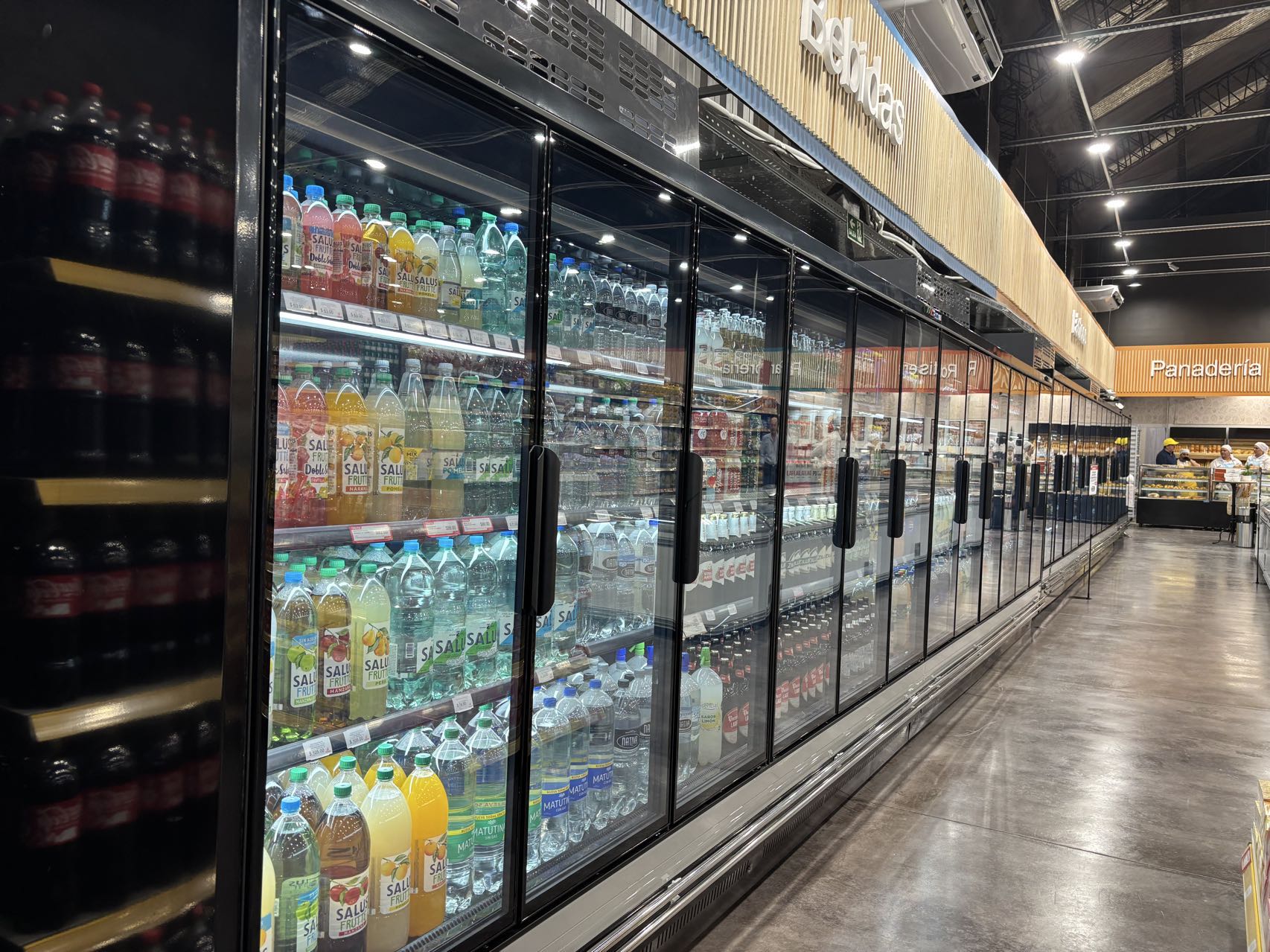
When a Sliding Door Refrigerator uses glass doors, visibility becomes another part of the storage system.
A transparent door allows users to see the general condition of the cabinet before opening it. This can make it easier to identify where a particular product is located and determine whether additional stock is needed.
Visibility can be especially useful when the refrigerator contains several product categories. Instead of repeatedly opening the cabinet simply to check its contents, users can inspect the refrigerated space through the glass.
However, a transparent door should not be considered only as a visual feature. Its insulation and sealing performance still have an important role because the refrigerator must maintain a stable internal environment. The door design therefore needs to balance visibility, accessibility, and thermal performance.
Which Products Work Well With This Type of Storage?
The suitability of a sliding-door refrigerator depends partly on the size and shape of the products being stored.
Packaged foods, beverages, prepared ingredients, dairy products, and other regularly handled refrigerated items can often be organized effectively when the shelf dimensions correspond to their packaging.
For products with different heights, adjustable shelf positions can be useful because the internal space can be changed according to the actual load. Instead of maintaining identical spacing throughout the cabinet, different sections can be configured for different product dimensions.
This approach can reduce unused vertical space and make the refrigerated cabinet easier to organize over time.
What Should Be Considered When the Cabinet Size Is Already Determined?
When the available installation space has already been fixed, the next step is not simply to choose the largest refrigerator that will fit. The more useful question is how the available dimensions can be converted into practical storage.
Several factors should be considered together:
- Cabinet depth: Determines how far products need to be stored inside the refrigerator.
- Internal height: Influences the number and spacing of usable shelf levels.
- Door configuration: Affects access to different sections of the cabinet.
- Product dimensions: Determines whether the available shelves can be used efficiently.
- Storage density: Influences how freely refrigerated air can move around stored products.
- Access frequency: Helps determine which products should be positioned in the easiest-to-reach areas.
These factors are connected. Increasing cabinet depth, for example, may increase theoretical capacity while also making the rear storage area less convenient. Adding more shelf levels may increase storage positions but can reduce flexibility for taller products.
The most suitable configuration is therefore not necessarily the one with the largest volume. It is the one that matches the relationship between the cabinet, the products, and the way the refrigerated space will actually be used.
When Is a Sliding Door Configuration Worth Considering?
A sliding-door design becomes particularly practical when refrigerated storage needs to coexist with limited working space. It can help reduce the area required for door movement while maintaining access to the internal cabinet.
It is also worth considering when the refrigerator needs to be integrated into an existing equipment layout. Instead of treating the refrigerator as an isolated unit, the door movement, surrounding equipment, walking paths, and available working area can all be considered together.
For larger commercial refrigeration projects, this approach can be even more important because a small difference in door movement or cabinet dimensions can affect the usability of the entire installation area.
Choosing the Right Sliding Door Refrigerator for a Specific Application
The best configuration depends on more than capacity. A practical evaluation should begin with the available installation space, followed by the dimensions and types of products that need to be stored. From there, cabinet depth, shelf arrangement, door configuration, temperature requirements, and storage density can be matched to the application.
For projects requiring a specific Sliding Door Refrigerator configuration, manufacturers can also evaluate cabinet dimensions, door quantity, internal layout, temperature range, and installation conditions together. This makes it possible to develop a refrigeration configuration around the actual storage requirements rather than simply selecting a standard cabinet based on volume.
FAQ
Does a Sliding Door Refrigerator save floor space?
Its main space advantage comes from the door movement. Because the doors slide horizontally, less front clearance is generally required compared with a hinged door that swings outward.
Is a larger refrigerator always better for storage?
Not necessarily. A larger cabinet may provide more theoretical volume, but poor shelf spacing or excessive depth can make part of that space difficult to use efficiently.
Are glass sliding doors suitable for commercial refrigeration?
Yes. Glass doors can improve visibility and make it easier to identify stored products. Their insulation and sealing performance should also be considered when evaluating the complete refrigerator.
How does product size affect refrigerator configuration?
Product height, width, depth, and packaging shape all influence shelf spacing and cabinet dimensions. Matching internal storage space to actual product dimensions can improve the practical use of the refrigerator.
Can the internal layout of a Sliding Door Refrigerator be customized?
Depending on the equipment design, cabinet dimensions, shelf arrangement, door configuration, and other specifications can be evaluated according to the application and installation conditions.
Post time: Sep-24-2026


