
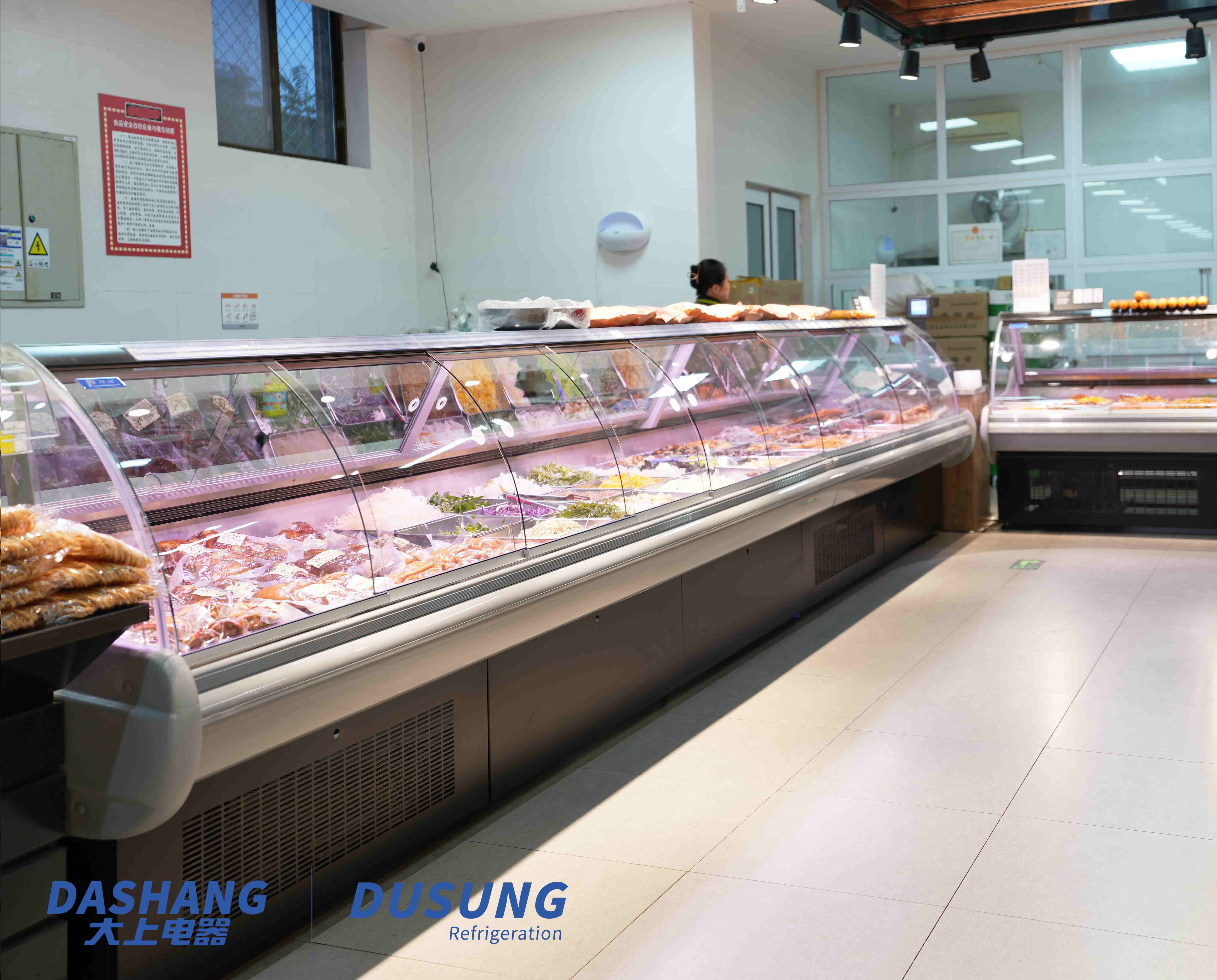
A Curved Sliding Door Meat Chiller is not useful simply because it combines glass, refrigeration and a service counter. Its real value appears when the front of the cabinet and the back of the cabinet are treated as two different working surfaces. Customers need a clear, attractive view of fresh meat, while staff need fast access for serving, restocking and reorganizing trays. The cabinet succeeds when both sides work at the same time without making the display look crowded or the service process feel awkward.
This makes the product different from a standard storage refrigerator. A meat counter is judged visually before anyone thinks about refrigeration. If the glass is difficult to see through, trays sit too deep, colors look uneven, or staff are constantly opening a large rear door into the aisle, the entire counter feels less organized. A Curved Sliding Door Meat Chiller therefore has to manage presentation, access and cooling as one connected system.
How a Curved Sliding Door Meat Chiller Serves Two Audiences
The customer stands in front of the curved glass. The staff member works behind the sliding doors. These two people look at the same cabinet but expect completely different things from it.
For the customer, the priority is visibility. Product rows should be easy to compare, the front edge of the display should not feel visually heavy, and the glass should support a natural line of sight toward the meat rather than creating a barrier. Curved glass can help soften the visual transition between the top and front of the counter, especially when products are arranged across a relatively wide display deck.
For the staff member, visibility is not enough. The rear side has to support movement. Trays may need to be replaced, portions may be served, labels may be checked, and the display may be reorganized several times during the day. Sliding rear doors matter because they open within the cabinet line instead of swinging outward into the working aisle.
The most useful way to understand this product is therefore not “front glass plus rear doors.” It is a cabinet with two operating faces: one for choosing and one for working.
What Customers Notice First in a Curved Sliding Door Meat Chiller
Fresh meat is highly visual. Customers often judge color, cut shape, fat distribution, portion size and surface condition before asking anything about the product. The display should make those differences easier to read.
A good Curved Sliding Door Meat Chiller helps by controlling the relationship between sightline, tray depth and display height. If the display surface is too low, products can disappear behind the counter edge. If it is too deep, rear rows become less visible. If trays are stacked too tightly, the display starts to look like storage rather than presentation.
Instead of trying to fill every centimeter, the counter should create a clear visual rhythm. A practical arrangement often uses:
- consistent tray orientation so the display does not look random;
- enough spacing to separate different cuts or categories;
- labels positioned where they do not block the product;
- a front row that is visible without hiding the rows behind it;
- display depth that matches the size of the meat trays actually used.
This is why “more capacity” is not always the best objective for a service meat cabinet. The visible surface is part of the product experience. A slightly less crowded cabinet can make each tray easier to understand and can make the entire counter look more controlled.
How Rear Access Changes the Curved Sliding Door Meat Chiller Workflow
Behind the counter, the same cabinet behaves very differently. Staff do not spend time admiring the curved glass. They repeatedly reach in, remove a tray, replace stock and close the cabinet again.
Rear sliding doors change this routine because they divide access into smaller movements. A staff member can open only the section needed for a specific tray instead of swinging a full door into the workspace. This is especially useful when the service aisle is narrow or when several people work behind the same counter.
The sliding format also encourages clearer product zones. If certain cuts are placed behind one section and other products behind another, staff can develop a more predictable service pattern. That reduces unnecessary searching and limits how much of the chilled space is exposed during each access event.
The important point is not that sliding doors are automatically “better” than every other door style. Their advantage comes from the service environment. They make most sense when rear clearance is limited, access is frequent and the counter needs to remain easy to operate during busy periods.
The Middle Zone: Where Display and Refrigeration Meet
Between the customer side and the staff side sits the actual refrigerated display area. This is where the cabinet has to protect product condition without making the meat look hidden inside a cold box.
Cold-air movement should support the full display surface, but the product arrangement must also respect that airflow. Overfilling a tray, stacking packages above the intended load line, or pushing products against an air outlet can create uneven conditions. The result may not be dramatic equipment failure; more often it appears as small differences across the display, such as some areas drying faster or recovering more slowly after service.
The display deck should therefore be treated as a controlled zone rather than empty space to be filled. Product height, tray size, spacing and airflow are connected. Staff training matters because the same cabinet can perform very differently when one team follows the intended loading pattern and another team treats the counter like a bulk storage box.
Four Visual Symptoms That Tell You the Counter Is Not Working Well
A meat display often gives early clues before anyone checks technical data. These clues are useful because they connect what the customer sees with what is happening inside the cabinet.
1. The front rows look strong, but rear rows look dull. This may indicate that display depth, lighting angle or airflow is not working evenly across the full surface.
2. The glass becomes visually distracting during service. Fingerprints, condensation or reflections can turn the curved front into a barrier. Cleaning routines, environmental humidity and anti-condensation design all matter.
3. Staff keep moving trays just to reach other trays. This usually means the internal arrangement does not match the service sequence. The cabinet may have enough volume but poor working access.
4. The display looks full but difficult to understand. Too many tray sizes, inconsistent orientation and excessive stacking can reduce visual clarity even when the product is properly chilled.
These are not simply merchandising problems. They show why the cabinet should be evaluated as a complete working counter.
When This Product Format Is Especially Useful
A Curved Sliding Door Meat Chiller is particularly suitable when the counter has to combine direct staff service with strong product presentation. But the final configuration should follow the service model rather than a generic template.
A butcher counter with large cuts may need a different display depth from a counter selling smaller portions, while a deli-meat area may prioritize frequent rear access. The same cabinet type can therefore be configured differently according to the product and service routine.
Before defining the cabinet, clarify tray sizes, display length, rear aisle width and expected opening frequency. These details are more useful than choosing by external width alone.
Turning the Display Requirement into a Practical Cabinet
For projects that need a service meat counter rather than a standard storage cabinet, DUSUNG can provide refrigerated display solutions with different dimensions, glass structures, rear-access arrangements and matching counter configurations. The aim is to match the equipment to the real display surface and service routine instead of forcing every project into one fixed layout.
If you are planning a meat counter, the most useful starting information is simple: product type, tray dimensions, required display length, service direction and available installation space. With those details, the cabinet configuration can be matched more accurately to the way the counter will actually be used.
FAQ
Why use curved glass on a meat display counter?
Curved glass can create a smoother front sightline and reduce the visual weight of the counter edge. Its value is strongest when the display depth and product height are designed to work with that sightline.
Why are sliding rear doors useful?
They reduce the amount of rear clearance needed for opening and allow staff to access only part of the cabinet at a time, which can be useful in narrow service aisles.
Should a meat chiller be filled as much as possible?
No. The display should respect airflow, loading height and visual separation. Maximum physical fill does not always produce the best refrigeration or presentation result.
What information is useful before configuring a meat chiller?
Product type, tray size, display length, rear working space, expected service frequency and installation dimensions are more useful than choosing a cabinet only by external width.
Post time: Sep-17-2026


